&geometry(315x90) "Gippsland Veterinary Group")
Selenium Deficiency in Livestock | Cattle and Sheep
Selenium Deficiency - its impact on cattle and sheep
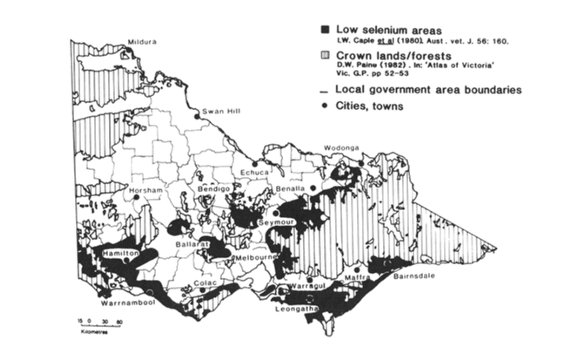
Selenium (Se) is an essential trace element required for a range of metabolic, immunological, and reproductive pathways in sheep and cattle. Pretty much all of South Gippsland has significantly Se-deficient soils. High annual rainfall and light acidic soils lead to rapid leaching of Se from the topsoil. Exacerbating this is the sulphur in super phosphate fertilisers inhibit the uptake of Se by pasture species. When pasture levels fall below 0.05 mg Se/kg dry matter, clinical Se deficiency will occur.
Selenium has two key metabolic roles in livestock - firstly as the core of an important antioxidant enzyme (glutathione peroxidase) and secondly as part of the enzyme complex that activates thyroxine in the thyroid gland. If these systems break down, a wide range of clinical and sub clinical disease ensues.
Key subclinical effects of deficiency vary a bit between sheep and cattle. Sheep mainly present with poor conception rates and lower lambing rates as a result of early embryonic death 3 to 4 days after conception. Whereas cattle generally present with a high incidence of retained foetal membranes, increased somatic cell counts and occasionally poor conception rates but this is less common than in sheep.
Clinical disease caused by severe deficiency may present in several different ways. White Muscle Disease (WMD) presents as lameness or stiffness when walking and progresses to recumbency in both cattle and sheep - young, rapidly growing animals are most susceptible. Affected lambs will generally have “steely’ wool. Occasionally, an acute form of WMD can affect the heart muscle causing sudden death, often triggered by mustering or handling of stock.
Damage to the thyroid hormonal system can result in weak calves and lambs that are very cold susceptible resulting in deaths at 2 - 3 days of age, particularly during bad weather.
While Se deficiency is common in South Gippsland, there are occasional cases of Se toxicity. Selenium supplements have a very narrow safety margin - acute toxicity occurs within several hours of an overdose with animals showing signs of acute respiratory distress, foaming from the nostrils, bloating and rapid death. There is no treatment for acute Se toxicity. There is some evidence that a sub-clinical toxicity can occur with long term over supplementation (eg in a dairy premix) that presents similarly to sub clinical deficiency with a negative impact on reproduction and udder health. A chronic clinical form of Se poisoning can occur in Northern Australia where specific plants accumulate Se.
Selenium deficiency is easily diagnosed with a blood test - testing of 10 - 12 animals from a group is needed to get a statistically representative sample.
As Se deficiency is common, there are a wide range of supplements available in the market that range from short acting to long acting products. Cobalex + Se, Multimin, Marksmin and Selpour are examples of short acting supplements that are designed to be used to top up base level supplements at times of high demand. Selovin LA is a long acting Se injection and CoSeCure is a long acting rumen bolus (also contains copper and cobalt) that are designed to treat the base level mineral deficiency for 8 - 12 months. The best product for your stock will vary depending on class of stock, timing, facilities etc - talk to one of our vets for more information on what is going to work for you.