&geometry(315x90) "Gippsland Veterinary Group")
Ovine Johne’s Disease in Gippsland

Ovine Johne’s disease in Gippsland
In Gippsland, ovine Johne’s disease (OJD) remains a quietly entrenched constraint on sheep productivity, costing the sheep industry about $35 million per year nationally. The Gippsland climate, topography and farming systems combine to create some of the most favourable conditions for persistence and spread of Mycobacterium avium subspecies paratuberculosis (MAP) anywhere in Victoria. While producers are generally well aware of OJD, its day to day impact in Gippsland flocks is often underestimated because losses generally accumulate slowly over years rather than as “outbreaks”.
In practice, OJD in Gippsland is best regarded as a chronic background disease that must be managed continuously rather than episodically.
Why is Gippsland a high risk area for OJD?
Compared with drier Victorian sheep regions, Gippsland presents a near ideal environment for MAP survival. Consistently higher rainfall, combined with cooler summers, allows the organism to persist in paddocks for extended periods.
High stocking density increases the likelihood that lambs, most susceptible in their first months of life, are exposed to OJD early and repeatedly. In contrast to more opportunistic or cropping based systems, there is often limited scope to rest paddocks through cultivation or long pasture spelling.
The net result is that once MAP is established on a Gippsland property, natural environmental decline of contamination is slow, and infection pressure can persist for many years even when flock performance appears otherwise strong.
How OJD typically presents in Gippsland flocks
In Gippsland, OJD rarely occurs as an outbreak situation. More often, it presents as a persistent, low level problem: a gradual tail of light condition ewes in adult mobs, poor longevity in breeding ewes, or ongoing but “explainable looking” weight loss or scouring that ultimately fails to respond to nutritional improvement or parasite control.
Because feed availability is usually not limiting, affected sheep may maintain condition until late in the disease course, further delaying recognition. Worm burdens and trace element issues, also common in Gippsland, can easily mask or confound early OJD signs, allowing infection to progress largely unnoticed.
Prevention and Control
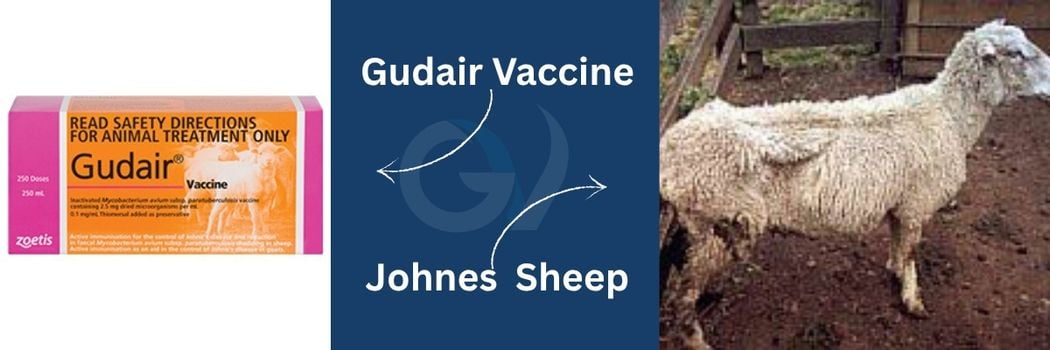
Given the risk factors for OJD in Gippsland, Guidar should be considered a core vaccine in the majority of flocks. Care is needed from an OHS perspective with Guidar, as self inoculation will result in serious medical issues. Only use the specific Guidar vaccinator gun to administer the vaccine.
Whole drop lamb vaccination from 4 weeks of age, for each lamb drop every year, remains the most reliable approach for control—benefits accrue gradually over multiple years rather than immediately.
Although OJD is endemic, buying decisions arguably matter more in Gippsland. High environmental survival means that introducing a small number of high shedding or unvaccinated sheep can have disproportionate long term consequences.
The National Sheep Health Statement remains a critical risk assessment tool when buying stock, but it should be interpreted in context. Length of vaccination history, whole flock versus partial vaccination, and age class of purchased stock are often more important than a simple infected or non infected label, nothing is 100%.
Successful OJD control is generally about containment and suppression, not eradication. Flocks that perform well over time accept that OJD pressure will persist but act to blunt its impact through vaccination, disciplined buying, and practical management.