&geometry(315x90) "Gippsland Veterinary Group")
Antibiotic and Vaccine Storage | How Good is your System?
Antibiotic and vaccine storage - how good is your system?
All antibiotics and vaccines have very specific storage requirements as they break down over time. The rate at which they degrade depends on a range of factors such as temperature, exposure to light and exposure to air. All the storage requirements are listed on the product label and need to be followed if you are to have any confidence that the product is actually going to work when used in an animal.
A few examples are:
- Gonabreed - store at 2 to 8 °C. Do not freeze. Use within 28 days of opening. Protect from light.
- Depocillin - store below 8 °C. Use within 28 days of opening.
- Rhinogard - store at 2 to 8 °C. Do not freeze. Once reconstituted use within 8 hours.
- Accent - store unreconstituted product at less than 25 °C and protect from light. Once reconstituted, store at 2 to 8 °C and use within 7 days (12 hours if stored at 25 °C).
- Pestigard - store at 2 to 8 °C. Do not freeze. Protect from light. Use within 30 days of opening.
- Dectomax V - store below 25 °C.
The graph below shows the different rates of deterioration of three antibiotics (gentamicin, streptomycin and penicillin) when exposed to a temperature of 37 degrees.
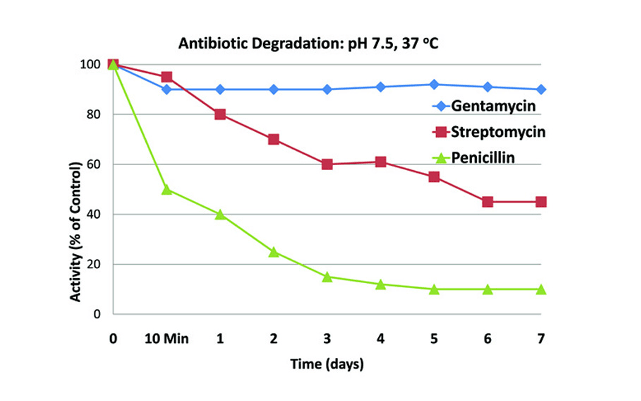
Expose penicillin to a temperature of 37 degrees for only 10 minutes and it has lost half of its potency, whereas gentamicin only loses 10% of its potency after 7 days at 37 degrees (NB we are not allowed to use gentamicin or streptomycin in food producing animals anymore).
All drugs and vaccines differ in their rates of deterioration over time when exposed to conditions outside the manufacturer’s recommendations. Freezing a pack of Pestigard or 7 in 1 will inactivate it completely. Freezing a bottle of Accent is okay.
Make sure your vaccines and antibiotics are stored in a reliable fridge, as many are not. Do not overfill the fridge, as the air needs to circulate freely. Do not store vaccines on the top shelf next to the element, as they are much more likely to freeze if something goes wrong. It is best to have bottles of water stored on the top and bottom shelves as these will help even out any temperature fluctuations over time. Do not store anything in the door where products will be exposed to temperature fluctuations every time the fridge is opened.
Have a plan for power outages. Make sure your fridge is on a circuit that is powered by a generator if needed.
It is a good idea to invest in a temperature monitor for your fridge. A number of commercial temperature loggers are available. Most allow alarm temperatures and time limits to be set and can deliver notifications to your phone and or email as needed. The ones we use cost around $450 for a setup for a single fridge, less than the cost of one pack of Pestigard.
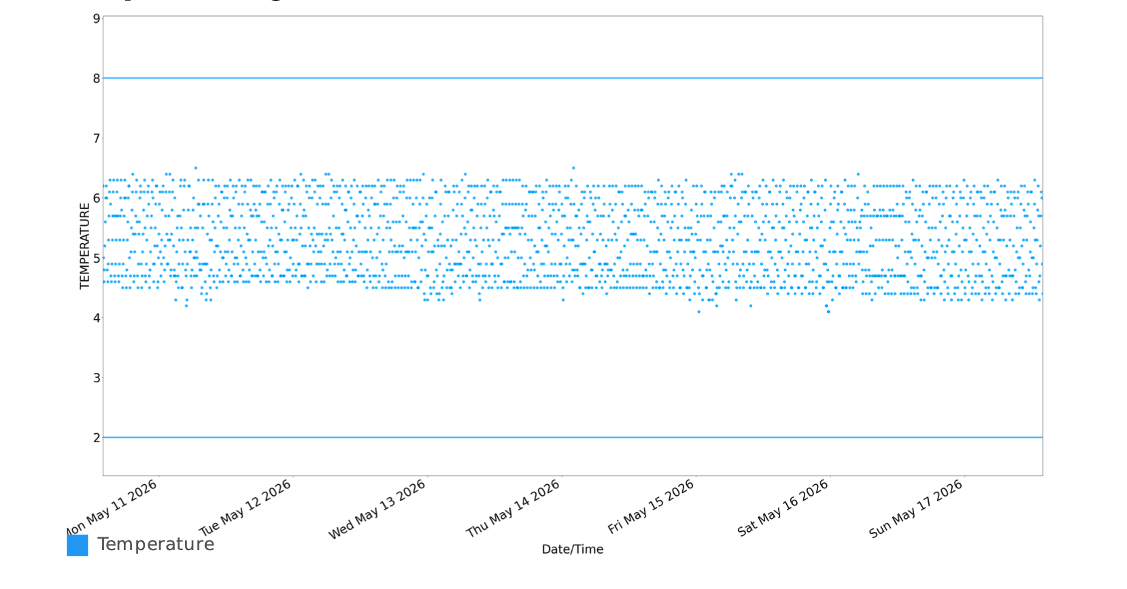
The above is the weekly report for our vaccine fridge at the Livestock and Equine Centre.
How are your drugs and vaccines stored? In a fridge that freezes everything near the back? Sitting on a shelf in the pit? On the back seat of the ute? Where was your leftover dry cow treatment stored during summer? Are they going to work when you need them to?